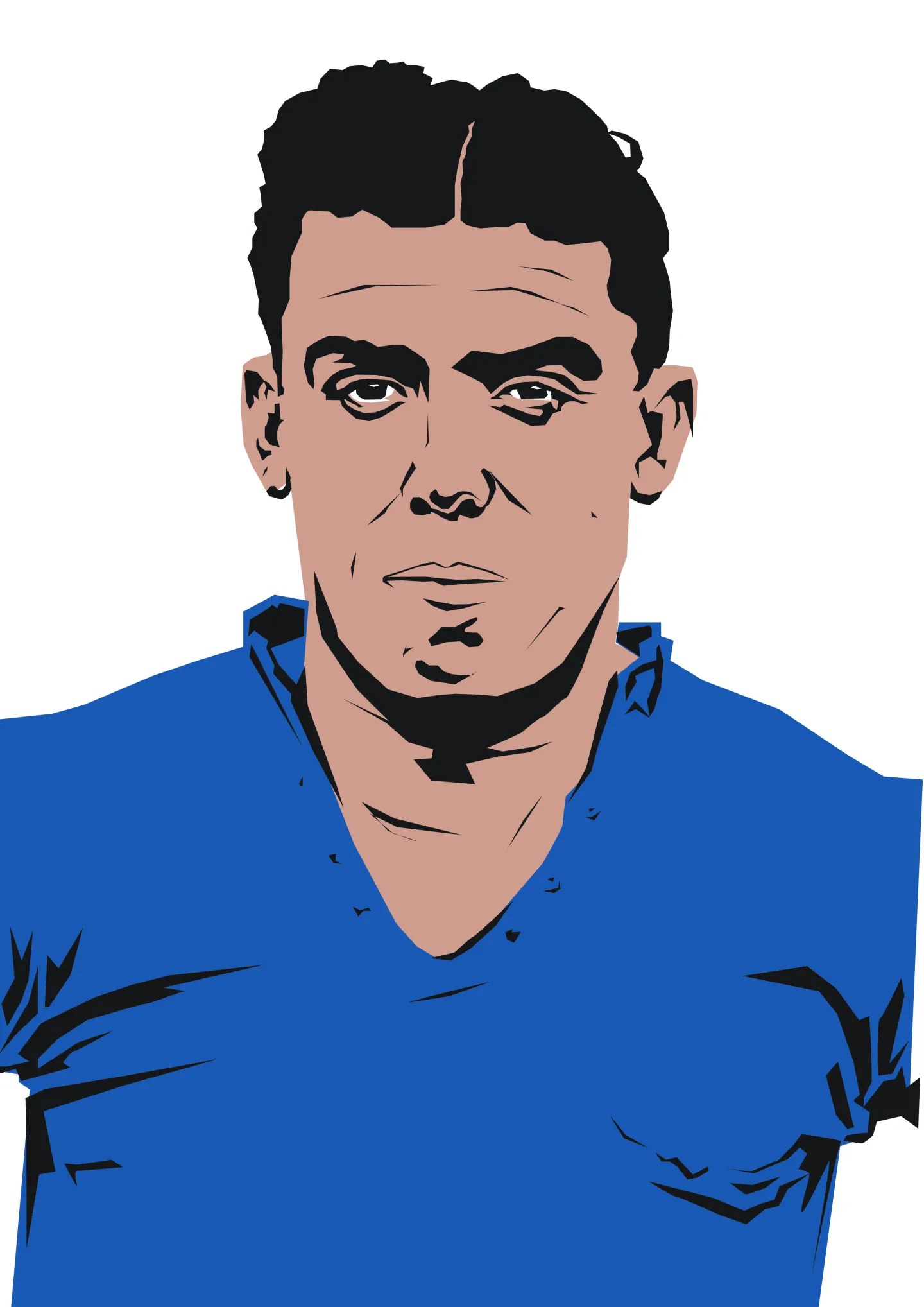
William Ralph “Dixie” Dean
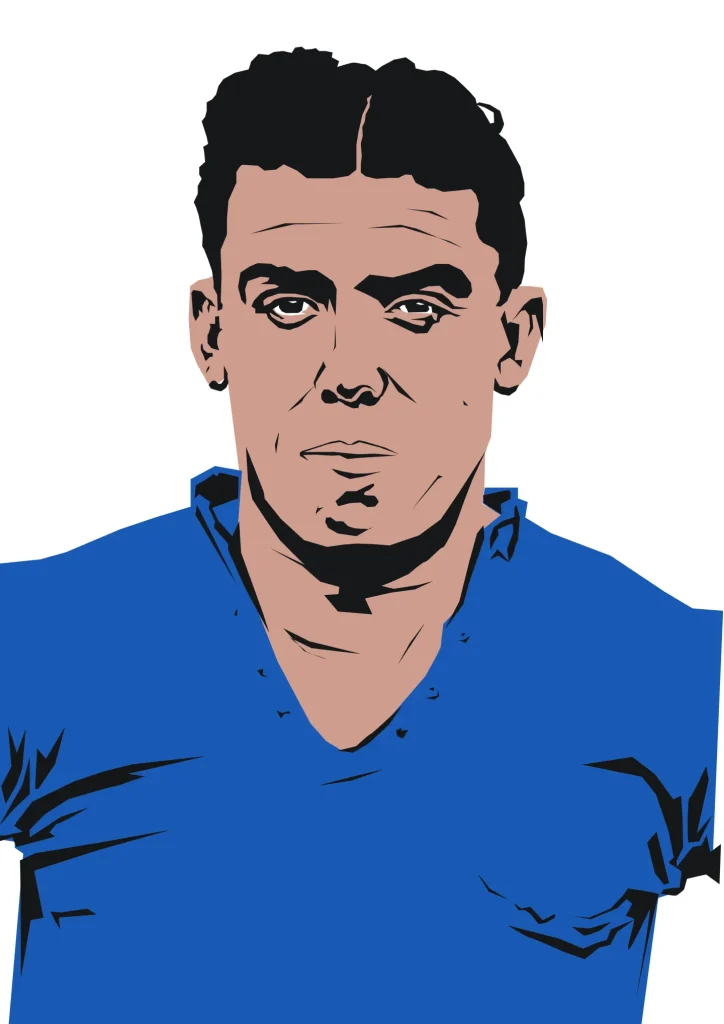
Back in the 1920s, Everton were in dire need of inspiration. After the break-up of the club’s title winning pre-war side, a rebuilding process was being undertaken. But progress was patchy and with the club spending more time looking down the table rather than up, something more was needed.
The club’s secretary-manager, Tom McIntosh, set out to hunt for that ‘something more’. Luckily, he didn’t have too far to look.
William Ralph ‘Dixie’ Dean, a young forward from Birkenhead, had been turning heads with his startling form at Tranmere Rovers during his short time with the Wirral club. In his first full season at Prenton Park, Dean found the back of the net 27 times in just 27 appearances. Along with attention from Everton, he was soon attracting interest from a wealth of other top-flight clubs, including Arsenal, Newcastle United and Liverpool.
But where would he go? The answer arrived on Monday 16 March 1925: the day that Dean of Prenton Park became Dean of Goodison.
‘One afternoon,’ the man himself said in an interview with the sports writer John Roberts years later, ‘I cleared off to the pictures and when I got home my mother told me Mr McIntosh from Everton had been and was waiting for me at the Woodside Hotel. I ran the two and a half miles there. I couldn’t get there quick enough. Mr McIntosh asked me did I want to play for Everton, and that was that.’
Dean didn’t even ask how much he was getting paid. He simply said yes, grasping the dream of playing for his boyhood club.
He was signed for £3,000, no small amount to splash out on a teenager by the standards of the time. But his potential was widely understood. And for Everton, a side languishing in the nether regions of the table and averaging about a goal per game, his promise of potency was worth the outlay.
Aware of the pressure the fee might place on the teenager, the Liverpool Daily Post and Mercury pleaded for patience, saying, ‘It is probably the heaviest transfer fee that has ever been paid for a mere boy.… It is to be hoped the crowd will not make a “god” of Dean. He is very human and has many boy-like touches.’
Except he didn’t look ‘boy like’ for very long. After a haltering start, as the youngster found his feet, Dean quickly became the goal scoring machine that Everton sorely needed. By the close of the 1925/26 campaign, his first full season with the club, the cry of ‘Give it to Dixie’ would ring out around Goodison whenever Everton had the ball, so devastating had he become.
There are competing theories as to how he became ‘Dixie’. For a long time, it was assumed to be a reference to his dark complexion, his likeness to someone from the deep South in the USA (Dixieland). More recently though, Tranmere Rovers club historian, Gilbert Upton suggested that it was a corruption of his childhood nickname, ‘Digsy’ (acquired from his approach to the children’s game of tic, where Dean would dig his fist into the backs of other [hence ‘Digsy’]).
Whatever the truth, ‘Dixie’ fast became the kind of player that Everton had sorely needed, ending that inaugural campaign with 33 goals. And yet, the optimism that surrounded this new hero was very nearly brought to an abrupt end in June 1926 when Dean suffered a dramatic brush with death.
A motorbike crash in North Wales resulted in Dean suffering a fractured skull, a broken jaw, eye injuries and concussion. He was unconscious for 36 hours and initially it was thought he could die. And even when that possibility had receded, there were still fears that he might not play again, potentially robbing Everton of one of its stellar talents before his career had even got going.
But fortune smiled on the Everton cause for once. Dean recovered. He was back playing for Everton within fourth months. Although the recovery was not as quick as Dean had liked, from a medical perspective it was exceptionally fast. On his return, away against Leeds United at Elland Road, any fears about the accident’s long-term effects quickly receded when he powered home a header from a corner.
Dean’s almost superhuman ability in the air during his career, gave rise to a peculiar and long-held rumour after the crash, that metal plates had been inserted in his head. It was thought that these enabled him to head the ball with increased power. But it was an apocryphal tale. The metal plates in question had been inserted in his jaw and then removed when the bone had set. It was a good story though, one that appeared to make more sense than the mundane reality, that his Godlike ability in the air was simply down to practise and hard work.
Upon recovery, Dean continued to score freely, gradually establishing himself as one of the most prolific attacking players in the country. But as yet, the Everton team that surrounded him was failing to reach his lofty standards. That changed in the 1927/28 campaign, a season that would cement Dean’s legacy as not just an Everton legend but also one of the greatest forwards to ever play the game.
As part of the rebuilding process that had been happening at the club, Everton had recruited the talented outside-right Ted Critchley in the summer. With Alec Troup on the left, the Blues now had two gifted providers on either wing, two players who could provide the kind of ammunition that Dean craved. It was a partnership that would yield spectacular dividends.
Dean’s form that season was simply mesmerising. By November, with Everton top of the league, the colossus of Goodison had played 15 games and found the net 27 times, including hat-tricks against Portsmouth, Leicester City and Manchester United.
Tentatively, Dean had his sights on the English goalscoring record, which had recently been set by George Camsell of Middlesbrough, who had scored 59 goals during the 1926/27 campaign (albeit in the second tier). With just over a third of the season gone, he was nearly half-way there.
Over the months that followed, Everton remained in the hunt for the title and the man himself closed in on Camsell. By late March, after bagging a brace in a 2–2 draw against Derby County, he reached 45, claiming the record for most goals in a First Division season (previously held by Ted Harper of Blackburn Rovers).
As the season closed, both the club and Dean (although he slightly less so) were still well positioned to claim their respective titles. In the league, with three games to go, it was a head-to-head battle between Everton and Huddersfield Town for the title. And in the goalscoring stakes, Dean needed nine more goals to beat Camsell’s record. For Everton’s unstoppable centre-forward, it was a tough proposition but not one beyond his skills.
Dean bagged two in a 3–2 win over Aston Villa and then followed this with four in a 5–3 victory over Burnley. At the same time, Everton pushed further ahead of Huddersfield and, after the Yorkshiremen lost their penultimate match of the season (a game in hand away at Villa), the title was Goodison bound.
The presenting of the trophy would have been exciting enough for Evertonians. After all, it was the first time in over a decade that the club had won any silverware. But there was also the issue of Dean’s record to consider. Three more goals were needed to best Camsell, and there was just the one game left to do it.
But would the great man play?
In the penultimate match of the season, Dean had sprained a leg muscle and limped off. With Saturday approaching and the leg continuing to give him some jip, Everton’s trainer/physio Harry Cooke sprang into action.
‘From the Wednesday night until the Friday, he was with me at home, my home in Alderley Avenue, Birkenhead,’ Dean told John Roberts. ‘Old Harry kept putting clay plasters on [the muscle] until the Friday night, even leaving one on overnight as well. Old Harry cured it, and on the Saturday, of course I was fit.’
On the day itself, although the official attendance was said to be 48,715, it’s thought that around 60,000 (nervous) Blues crammed into Goodison to witness history being made.
Did the man himself share those nerves? Like he did before every home game, Dean caught the number 44 tram from Water Street, got off and walked along Goodison Road, chatting all the time to fellow fans. He was relaxed, motivated and, as he revealed to John Keith in Dixie Dean: The Inside Story of a Football Icon, confident in his abilities:
‘I needed three goals against Arsenal, who were the greatest club in the land. But that didn’t worry me whatsoever. I always used to think, “I’m better than you.”’
Despite Arsenal taking a quick lead on the two-minute mark, the hopes and dreams of the fans were given a huge boost almost immediately after, when Dean opened his account with a typically powerful header.
Not long after Arsenal had restarted proceedings, the man himself was then brought down in the box. Penalty to Everton! There was only one person to take it. Goodison held its breath.
‘I intended to place the penalty in the corner,’ he later recalled. ‘Instead it went in-between the keeper’s legs. It wasn’t one of my better kicks.’
Not that it mattered. Camsell’s record had been equalled. And, with most of the game remaining, Dean needed only one more to nudge out in front.
As the crowd waited for him to strike again, Arsenal levelled. With the title secured and that scoring record exercising minds, it was one of those rare occasions at Goodison when the opposition’s efforts to secure victory hardly mattered.
What was of more concern to the increasingly agitated crowd as the minutes ticked along was the growing impregnability of the Gunners’ defence, which seemed determined to spoil the day. No matter what Everton threw at it, the back line remained resolute.
And then, with around four minutes left, Everton won a corner. Troup trotted out to take it. The Football Express takes up the story: ‘As the ball came in, Dean was in the midst of a bunch of players – friend and foe, and when it was a case of whose head was going to reach the ball first, it was a foregone conclusion it would be Dean’s. He nodded the ball into the right-hand corner of the net.’
Goodison exploded. It was a noise so loud, so the legend goes, that it sent the pigeons around the Pier Head scattering off into the sky.
The remaining minutes of the match passed by in a deafening whirl of noise as the crowd sang and cheered without pause. When the end came, the pitch was flooded with Blues eager to celebrate not just the club’s first title win that decade but also the remarkable achievement of their beloved centre-forward.
Not that they would find Dean. Just prior to the game’s conclusion, the hero of the hour had already made a quiet exit, as he later confided to John Roberts: ‘I turned round to the referee and I said: “Look, I’m going off, if you don’t mind, tell them I’m going off for a ‘Jimmy’ or something.” And he said: “Listen, if I were you I’d be in there now.” I went off, and that was that, because I would have got murdered.’
Although Everton had much to thank Dean for, possessing a talent such as his did not come risk free for the Blues. During the ‘Dixieland’ era, there frequently existed two different and wildly contrasting versions of Everton. There was the side led by the talismanic Dean, which was capable of laying waste to all comers. And then there was the side that played without Dean, which often struggled, so over-dependent was it on him.
The cost of this over-dependence had been felt immediately after that title wining campaign, when an injury-afflicted couple of seasons for their dominant centre-forward had seen Everton struggle and eventually drop into the second tier – the first time that had ever happened to the club. Everton had powered back immediately, but, once again had only done so with Dean fit and leading by example.
But with a few additions to the squad, most notably the Manchester City forward, Tommy Johnson, the side that would eventually start life back in the First Division is widely regarded as the most complete of the ‘Dixieland’ era, one that would go on to claim the title at the first time of trying.
With Dean as the focal point, the Blues scored freely, finding the net on 116 occasions (a higher figure than in the breath-taking 1927/28 campaign). But, importantly, they were less reliant on their captain. In the previous title-winning season, Troup had come closest to Dean in the scoring stakes with ten goals (50 fewer than Dixie). In the 1931/32 campaign, Johnson chipped in with 22 and Tommy White with 18. These two complemented Dean’s more modest (yet still hugely impressive) 45.
Although that side managed to grab the FA Cup in the following season, beating Manchester City 3-0 in the final, it would sadly not go on to be the dominant force many had predicted. Final positions in the table began to tumble and the days of bringing home silverware faded away. The completeness of the title-winning side proved to be an aberration, meaning that the over-reliance on Dean came back to haunt Everton. Although always a threat when fit, injuries continued to limit his availability. And without him, Everton were mediocre at best.
But it was an over-reliance that had a shelf-life. Inevitably the closure of Dixieland would always have happened at some point, likely hastened by the tolls that injuries were taking on Dean’s body. Although as his 30s approached he remained a world beater on his day, those days were becoming less frequent. But two factors ensured a premature end to his time at Goodison.
The first of these was the appointment of Theo Kelly as club secretary. The two never got on. Dean thought Kelly dictatorial and not a football man. Kelly saw Dean as an impediment to his plans to modernise the squad, his attempt to shake-off the mediocrity that had beset the club in the mid-1930s.
Without an alternative to Dean, Kelly’s hand would have been weakened. Unfortunately for the club’s captain, Kelly had been able to source just such an option when the young forward, Tommy Lawton was signed from Burnley in January 1937. Even Dean himself understood that Lawton had been bought as his replacement. To a lesser man, the possibility of petty jealously might have arisen from the signing. After being the dominant force at Goodison for so long, it would naturally have hurt to see a young player brought in as his replacement. But Dean wasn’t like that.
So the story goes, on entering the dressing room for the first time, Lawton asked Joe Mercer, ‘Where’s Dixie, then?’, so eager was he to meet his idol.
Almost on cue the dressing-room door burst open ‘I’m here,’ announced an unshaven Dean. Marching over to the young arrival, he shook his hand vigorously. Then, his arm round Lawton’s shoulders, he took him to one side. ‘I know you’re here to take my place,’ he said. ‘Anything I can do to help you I will. I promise, anything at all.’
And he did. As Gordon Watson, who played at inside-left for Everton at the time, later recalled:
‘Lawton and Dean used to work together under the main stand, Dean throwing up a large cased ball, stuffed with wet paper to make it as heavy as a medicine ball.’
With such a tutor on hand, it was no surprise that Lawton quickly adapted to life at Goodison. And by the beginning of the 1937/38 season, Kelly finally had his alternative to Dean ready to make the next step. Three matches in, Kelly felt emboldened to do what would have once seemed unthinkable. Dean was dropped. He barely featured again and spent much of the remainder of his time with Everton in the reserves.
His last game in a blue shirt came in the Liverpool Senior Cup semi-final against South Liverpool at Holly Park in March 1938. Thousands turned up to see Dean play (proving his continued ‘box office’ appeal). Although not at his best, he still found the net, scoring the final goal in Everton’s 4–1 victory.
A few days later, fans and the football world alike were stunned when it was announced that Everton’s legendary centre-forward had been sold to Notts County. Neatly, from Kelly’s perspective, the fee was £3,000, exactly the same amount as Everton had paid Tranmere Rovers for the young Dean all those years ago.
Dean’s time in Nottingham was brief, and after just nine games and a handful of goals he moved on. From there, he crossed the Irish Sea and spent some time with Sligo Rovers, helping them to a runners-up position in the league and success in the Irish FA Cup Final. The outbreak of war in September 1939 ended any prospect of further adventures in Ireland and he eventually enlisted in the Royal Tank Regiment. During the war he made his last appearance, as a guest for York City in 1941. Of course, he scored.
After football, Dean spent some time running the Dublin Packet pub in Chester and later found employment, courtesy of John Moores, at Littlewoods, working as a security guard at their Walton Hall Avenue offices.
He passed away on 1 March 1980, age 73, after suffering a heart attack during a Derby game at Goodison. It was fitting, from one perspective, that it happened at the ground where he had made his name. This was the place forever associated with Dean, arguably the greatest Everton player to ever grace its turf.
Dean’s feats for the club have echoed down the generations. But, as impressive as the figures are, 383 goals for Everton in 433 appearances, they fail to tell the full story. Dean was Everton during the late 1920s and 1930s. He was a player who revived the fortunes of an ailing giant, hauling it out of its post-war doldrums, restoring it to the pinnacle of the game. A colossus, a man who made Everton a force to be reckoned with once again.