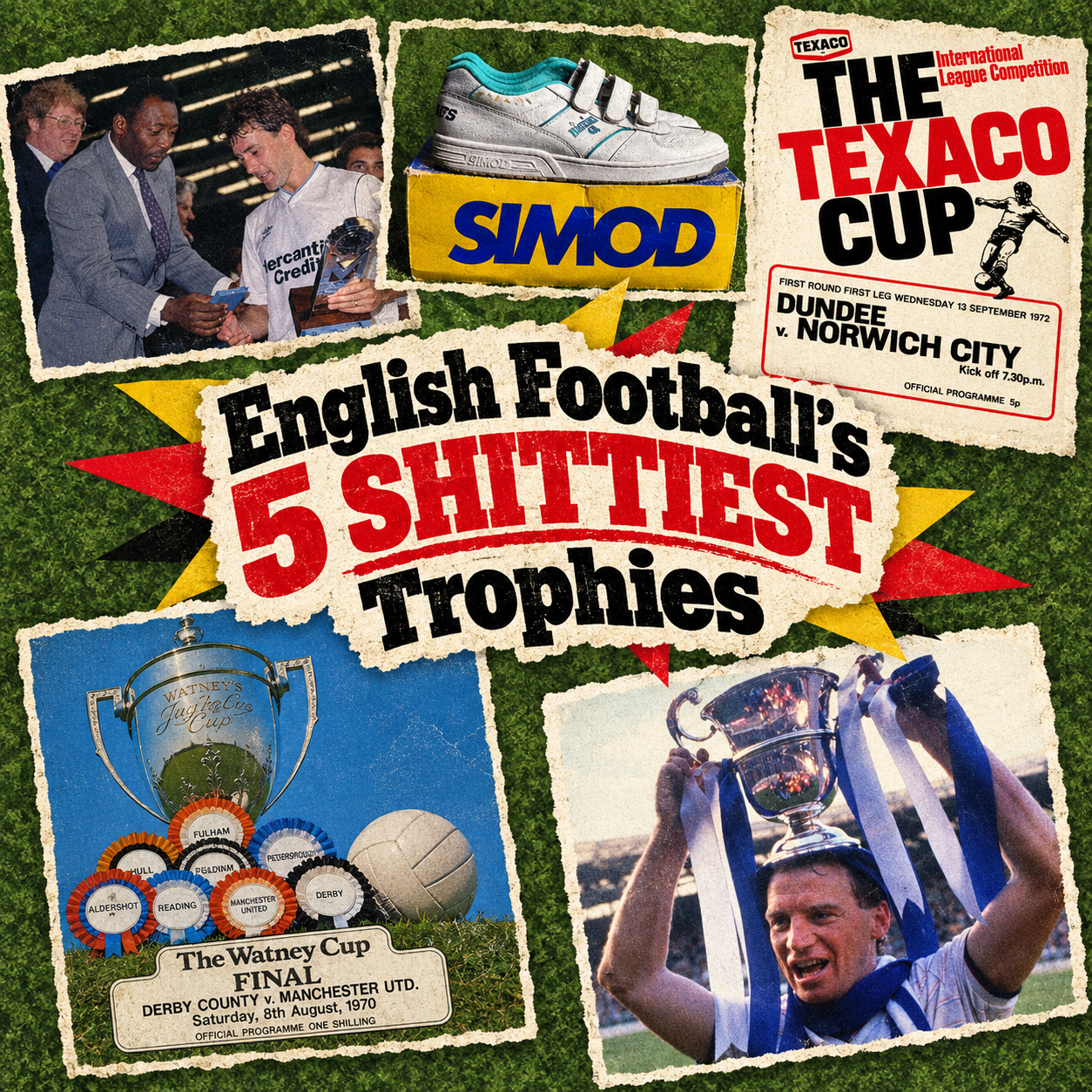
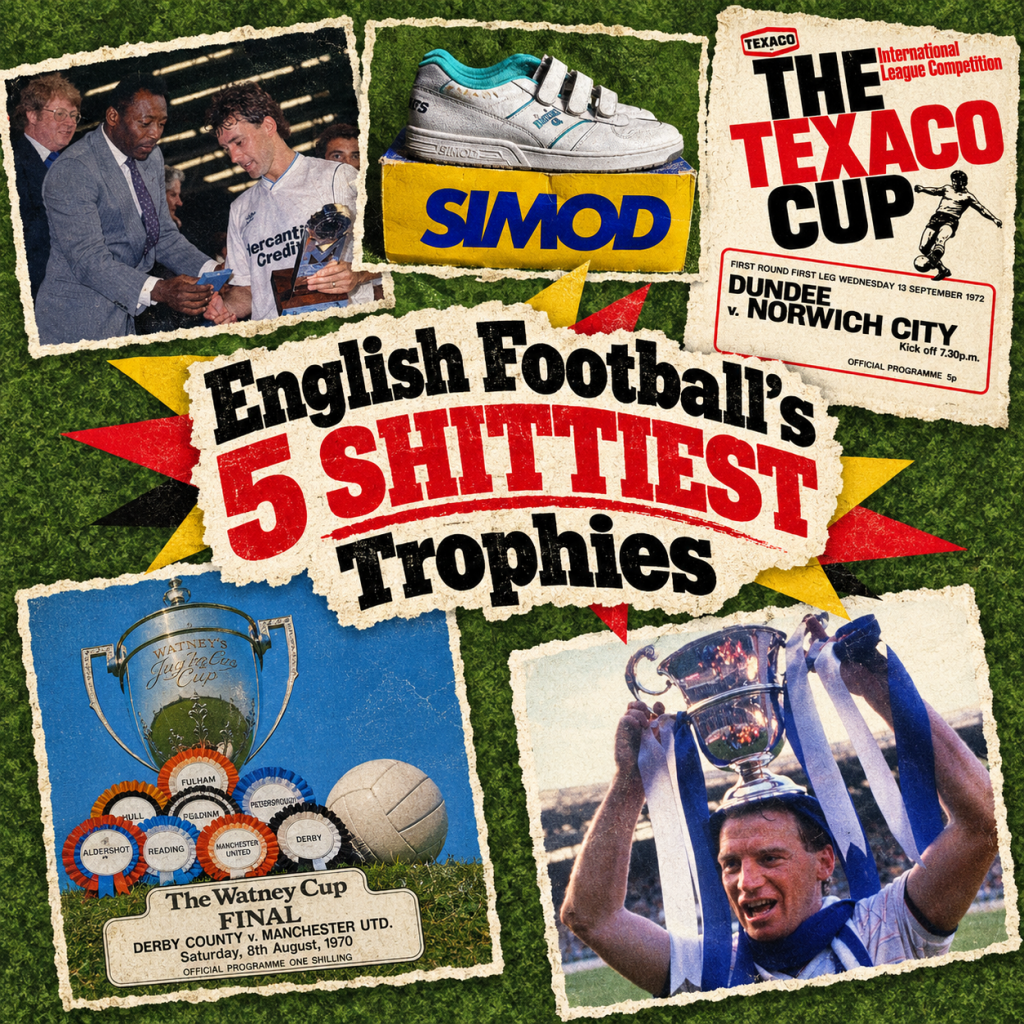
English Football's 5 Shittiest Trophies
The League Cup and the FA Cup might not be what they once were, but at least there is still some prestige in winning them.
That can’t be said for a handful of other cup competitions that have involved English clubs over the years. These were unmitigated shit and are largely forgotten by most fans (even those of teams that won them).
For your enjoyment, here are the five crappiest cup competitions ever to have graced our shores.
The Super Cup
“What a waste of time this is – out you go”. As managerial team-talks go, Howard Kendall’s motivation-sapping comments issued to his Everton team before they took to the field to face Norwich City in the group stage of the ‘ScreenSport’ Super Cup will hardly go down as one of the greats.
But they were depressingly apposite; perfectly capturing the sense of indifference towards the trophy that was evident amongst fans and players alike. Some cups just aren’t worth winning, and this was one of them.
The competition (which only ran for one season) was introduced in the wake of the European ban on English clubs following the Heysel disaster in 1985 and was solely for those teams who would have qualified for one of the European competitions.
It meant that a club like Everton, who had won the league the previous season and so had been looking forward to facing the likes of AC Milan, Barcelona or Bayern Munich in the European Cup, were instead facing Norwich City at Carrow Road on a wet autumnal evening. The sense of occasion was palpable.
Liverpool ended up winning the trophy, beating Everton 7-2 on aggregate over two legs. So inconsequential was this victory that Liverpudlians have never mentioned its since; something which goes against their tendency towards relentless self aggrandisement.
The Mercantile Credit Football Festival
The creators of this 1988 end-of-season tournament foolishly wedged the word football between two opposing linguistic poles. On one side you have ‘festival’, a word that suggests fun and frivolity. One the other you have ‘Mercantile Credit’ two words that when combined conjure up a soul-crushing sense of tedium.
Sadly for the people behind this event, it was the ‘‘Mercantile Credit’ bit that won out.
The tournament had been designed to celebrate the 100th birthday of the Football League and participants included big clubs of the day, such as Everton, Liverpool and Nottingham Forest, and some relative footballing minnows, like Tranmere Rovers and Wigan Athletic.
Even though the Football League had survived for years using the ninety minute format, the organisers thought a forty minute game would increase excitement. It didn’t. All it meant was an unusually high level of 0-0 draws, something that contributed towards a dramatic slide in the number of people turning up to Wembley to watch the games; one that saw figures declining from 40,000 on the opening day to just 17,000 for the final.
It was eventually won by Nottingham Forest, who beat Sheffield Wednesday in the final. Fittingly, Forest won that on penalties following a 0-0 draw.
The Full Members Cup
Another competition to fill the vacuum left by the loss of European football, the Full Members cup ran for seven seasons between 1985-1992 and was open only to full members of the Football League (those in the top two divisions).
With an eye to sporting excellence, during its inaugural season this trophy excluded those who had ‘qualified’ for Europe, essentially removing the best clubs in the country.
Although this ban was lifted during subsequent years, four of the ‘big-five’ clubs of the day, Liverpool, Arsenal, Spurs and Man Utd wisely chose to not participate, which only heightened the crushing sense of pointlessness that hung over the competition. The sole big beast to enter was Everton, a decision that could be said to first illustrate that perhaps all was not well at the Merseyside club.
Widespread indifference, average attendances of just 8000 and the return of European football eventually did for the competition in 1992.
If anything could be said to show just how sad a competition this was, then it’s the quality of the sponsorship. This was left to the lesser lights of Simod (makers of the kind of crap trainers your ma would buy you from the market, even though you’d asked for a pair of Addidas Gazelle) and then later to Zenith Data Systems (makers of the kind of crap data sysytems your ma would buy you from the market, even though you’d asked for an IBM data system or something).
The Watney Cup
In the wake of the 1970 World Cup, a tournament in which a rampant Brazil had illustrated to the world the excitement of attacking football, there was a belief here at home that what the people wanted was Goals, Goals Goals!!!
The Watney Mann Invitation Cup (sponsored by a leading brewery of the day) was the physical manifestation of this belief. It was a pre-season knockout tournament, contested by the two top-scoring teams from each of the Football League’s four divisions. But this didn’t necessarily include anyone that had been promoted.
The tournament did have some high points, such as the occasion when lowly Halifax Town beat a pretty full-strength Man Utd side 2-1. And it made a bit of history too, when Man Utd beat Hull via the first penalty shoot-out ever seen in England. George Best took the first penalty and then Denis Law became the first person to miss one.
But it was still a tournament greeted with indifference by the fans. Low attendances ensured that the Watney Cup was wound up after just four seasons. As a sad indictment, Derby County, who won the trophy in 1970 don’t even include it in their roll of honour.
The Texaco Cup
Here’s a great idea, let’s get some English teams that haven’t been good enough to qualify for Europe and pit them against some teams from Scotland. But not the good Scottish teams like Celtic and Rangers. No, lets again pick some of the crapper sides. Also, while we’re at it, why not throw in a few Irish sides too? After all, no prestigous international tournament is complete without the inclusion of Ballymena United.
And that in essence was the thinking behind the Texaco Cup, which debuted during the 1970 season.
Amazingly, the prospect of watching Huddersfield Town take on Morton initially caught the football public’s imagination in a way that the Simod Cup could only have dreamed of. But crowd numbers began to dramatically slide when it became evident that English teams were dominating the later rounds of the competition, robbing it of its vaguely international flavour.
Following the withdrawal of Irish sides in 1972 and then the competition’s abandonment by its sponsor, Texaco, in 1975, the cup became the Anglo-Scottish Cup. It limped on for a few more years but with the English sides increasingly being drawn from further and further down the leagues it was eventually put out of its misery in the early eighties.