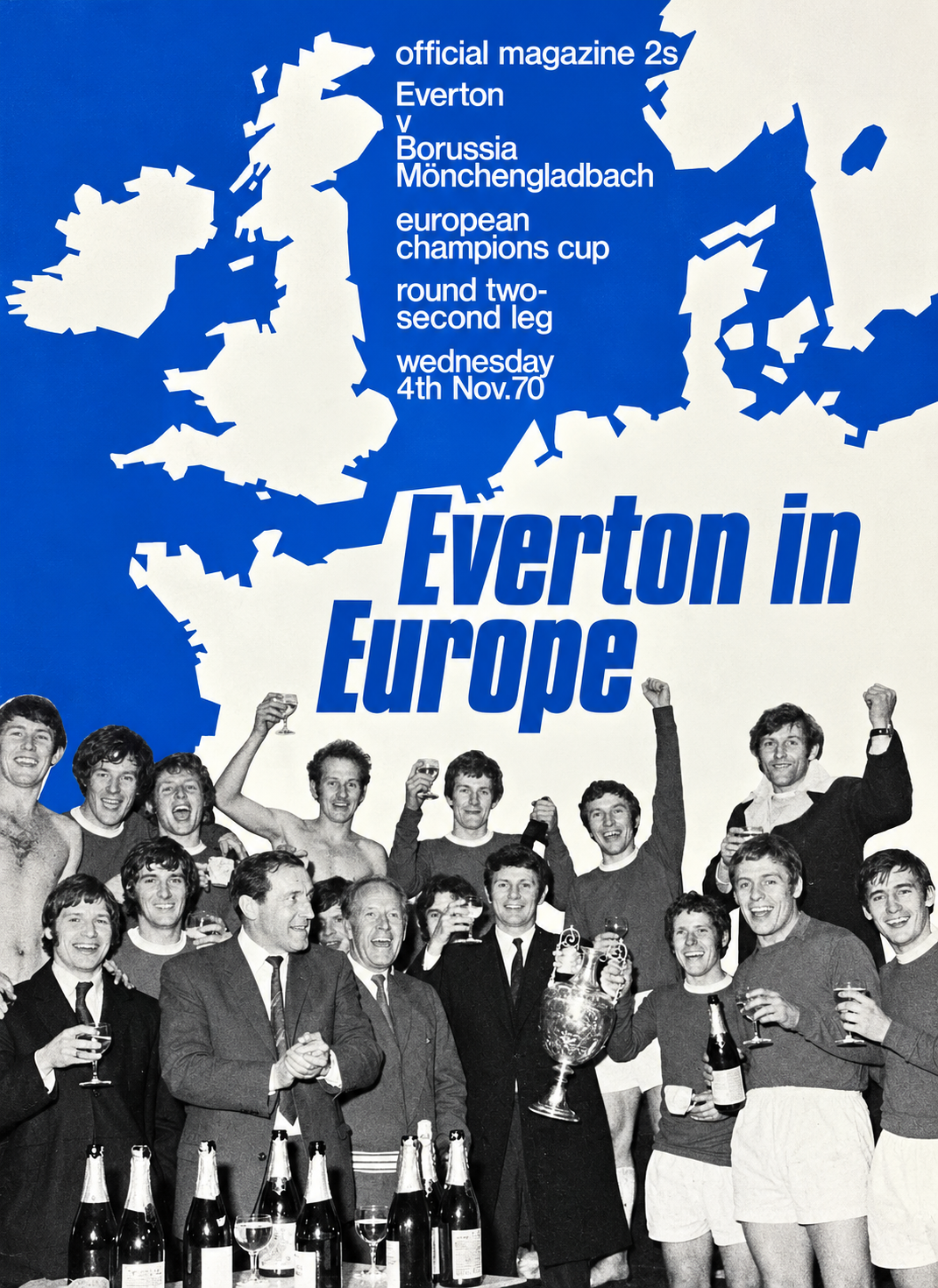
Penalty Kings - Everton v Borussia Mönchengladbach
It might not have enjoyed the allure that it possesses today but success in Europe still mattered in the 1970s. Although the league title remained the focus for domestic clubs, increasingly, doing well in Europe (and specifically the European Cup) came to be seen as marker of a great side.
After the disappointment of exiting at the hands of Inter Milan in 1963, Everton got a second bite at the European Cup in 1970.
For Harry Catterick’s men, the value of participation had become incrementally more important as the season progressed.
‘Far from dominating the league, as had been predicted following our stylish capturing of the title during the previous campaign, we’d struggled, says the former Everton defender, Roger Kenyon.
In part, this was attributed to a ‘World Cup hangover’ suffered by those amongst the squad (the likes of Ball, Wright, Labone) who had accompanied England to Mexico 70. They retuned jaded, as is often the case after international tournaments.
But the squad also suffered its fair share of injuries (Labone, Husband, Newton) and several players failed to reach the heights of the previous year. Most notably, the ‘Holy Trinity’ were far from the devastating force they had been when Everton had been storming their way to the title.
And so, by accident rather than design then, cup competitions (foreign and domestic) grew in importance as a way of redeeming the season.
Everton’s European adventure had begun easily enough with a routine 9-2 aggregate victory over the Icelandic champions, Keflavik. In parallels with 1963, when Everton had faced Internazionale in the preliminary round, the Blues were then drawn against an exceptionally strong European side, in this case Borussia Mönchengladbach.
Bundesliga champions and a side that would, along with Bayern Munich, dominate German football in the 1970s (and feature prominently on the European stage too), they were arguably one of the strongest sides in the competition.
‘It was certainly a test for us’, says David France, the man behind the Everton Collection. ‘But that wasn’t necessarily bad thing. We wanted to test ourselves against the best and felt, despite struggling that season, we had what it took to best anyone.’
After a creditable 1-1 draw at the Bökelbergstadion, in which Howard Kendall grabbed an all-important away goal for the Blues, the West Germans came to Goodison for the return leg in November 1970.
‘It was a big game’, says David France. ‘Although it might not have had the glamour of the modern-day Champions League, having the German Champions visit Goodison, especially under the lights, was something to look forward to. There was a big crowd, the atmosphere was fantastic and there was a sense that we were in for a special night.’
For the thousands who had turned up, the game could not have started any better. With just 24 seconds on the clock, an aimless long ball was poorly dealt with by the visitors, the clearance finding its way to Morrissey on the left wing. From the edge of the area, Everton’s industrious midfielder then drew two defenders towards him and clipped the ball towards goal.
‘The goalkeeper, who ended up having one of those nights were almost nothing would get past him, made his one mistake and misjudged the ball entirely, and it bounced in’, remembers Royle.
Was it a shot? ‘It was’ says Royle. ‘You could ask Johnny yourself but if you do, you’d better duck. Of course it was a shot.’
Everton had the perfect start. But there was no sense of the side resting on its laurels.
‘You couldn’t’, says David France. ‘They were a good side and we knew that they were going to come at us and they would have chances.
Although limited in their forays into the Everton half, the Germans remained dangerous. ‘You always had the sense that they had a goal in them. They looked good on the ball and carried that air of threat. You knew you were in a game when you watched them. A goal always seemed possible’ he continues.
With ten minutes to go before half time, a German free kick, some distance out from the 18-yard box, was curled in by Netzer. There, six yards out, the ball found an unmarked Laumen, who headed toward the Everton goal. At near point-blank range, Rankin managed to pull off an excellent save but unfortunately, the parried ball dropped down and bobbled in front of the empty Everton net. Of those in the box, Laumen was the fastest to react, pouncing and poking the ball over the line.
With the aggregate scores level, Everton had little option but to continue to press forward in the hope of recapturing the lead. But if the Blues had got lucky early on in the game with Kleff’s mistake, good fortune seemed to dessert the home side from that point as the German goalkeeper put in an outstanding performance for the remainder of the match, thwarting Everton, and particularly Royle on successive occasions.
‘It was frustrating but sometimes that just happens. Don’t forget, Andy Rankin in our goal had a decent night too, so overall both teams probably felt a bit frustrated’, says Royle.
Honours even after 90 minutes, the match went into extra time, where the sodden pitch and tired legs seemed to sap the energy from the game. The play became more ragged and clear-cut chances fewer. Not that there weren’t a few ‘hearts in the mouth moments’, notably Kleff’s acrobatic save from Royle’s goal bound effort and Koppel’s looping header which hit the Everton bar.
‘It was one of those games that could have gone either way but which a draw was probably a fair result’, admits Roger Kenyon.
But there was no possibility of it ending a draw. When the final whistle arrived it brought with it a novelty, the first ever European Cup shoot-out.
‘Even if you didn’t value the European Cup as much as the league of the FA, by that point, the whole of Gwladys Street where I was standing were desperate for Everton to go through. What we probably didn’t want though was Joe Royle taking that first pen’, remembers David France.
Never a forward renowned for subtlety, Royle opted to larrup the ball as hard as he could.
‘Raw power can work. On this occasion it didn’t. The keeper saved it, giving me the dubious honour of being the first person to miss a penalty in a European Cup shoot-out’, says Royle.
After this, Sielhoff and Ball both converted, before Laumen put his wide to level the scores.
‘It was incredibly tense to watch’, admits David France ‘Morrissey put us ahead before Heynckes drew them level.’
Then Kendall and Koppell both converted to leave the scores at 3-3 with one penalty to go each.
Up stepped Sandy Brown to attempt Everton’s fifth penalty. In the goal, crouched, his boots nearly sinking in the mud, Kleff attempted a slight little knee wobble, a Bruce Grobbelaar tactic long before Grobbelaar. Brown turned his back on these antics, walked away from the ball, spun calmly and strode purposefully towards the spot, smacking his effort past Kleff, ridiculing his diversion attempts in the best way possible.
That left Muller against Rankin to see if Everton would progress or if the Germans could push this to sudden death.
‘I remember him running up, the crowd around me surging forward to get a better look. He hit it low and to the left. But Rankin read it and palmed the ball away. It was an incredible moment. You’d have thought we won the competition by the reaction of the crowd (including myself)’ says lifelong Blue, John Monro.
Riding high on self-confidence, with thoughts of a possible final flittering through their minds, Everton were next drawn to face Panathinaikos in the quarter finals.
‘I think, at that point, we thought we could go on and win the thing’. admits Roger Kenyon. ‘Regardless of our indifferent league form, we were probably the strongest team left. But it wasn’t to be.’
The Greeks were battered at Goodison, but somehow managed to earn a 1-1 draw (vitally nicking an away goal).
This meant the Blues would need to take the game to Panathinaikos in the away leg to continue on their European adventure.
‘On a terrible, dusty playing surface, in front of an exceptionally hostile crowd (one that drenched the Everton bench in spit) and ruled over by a referee whose impartially has long been questioned, we faltered, the game ending goalless, meaning we were knocked out on the away goal rule. It was a bitter way to go out’, admits Kenyon.
A season that had promised so much was effectively ended a few days later when, exhausted after their Greek Odyssey, Everton were knocked out of the FA Cup semi-finals by Liverpool.
‘For me, I think that was the moment that the great Catterick side died’, argues Joe Royle.
Within a year, Ball was sold, rumours of dressing room dissent had spread and Everton went from a side that had been predicted to excel in the league to one that now had one eye on the relegation zone.
‘You can never know what would have happened had we got through against Panathinaikos or Liverpool. Either could have been the spark that brought things back to life. But in the end, those two results killed the side off’, says Royle. ‘And it’s a pity’, he continues, ‘because the talent was still there to do remarkable thing, as we proved against Borussia Monchengladbach. That was no small achievement. One of those great Goodison nights that live long in the memory.’