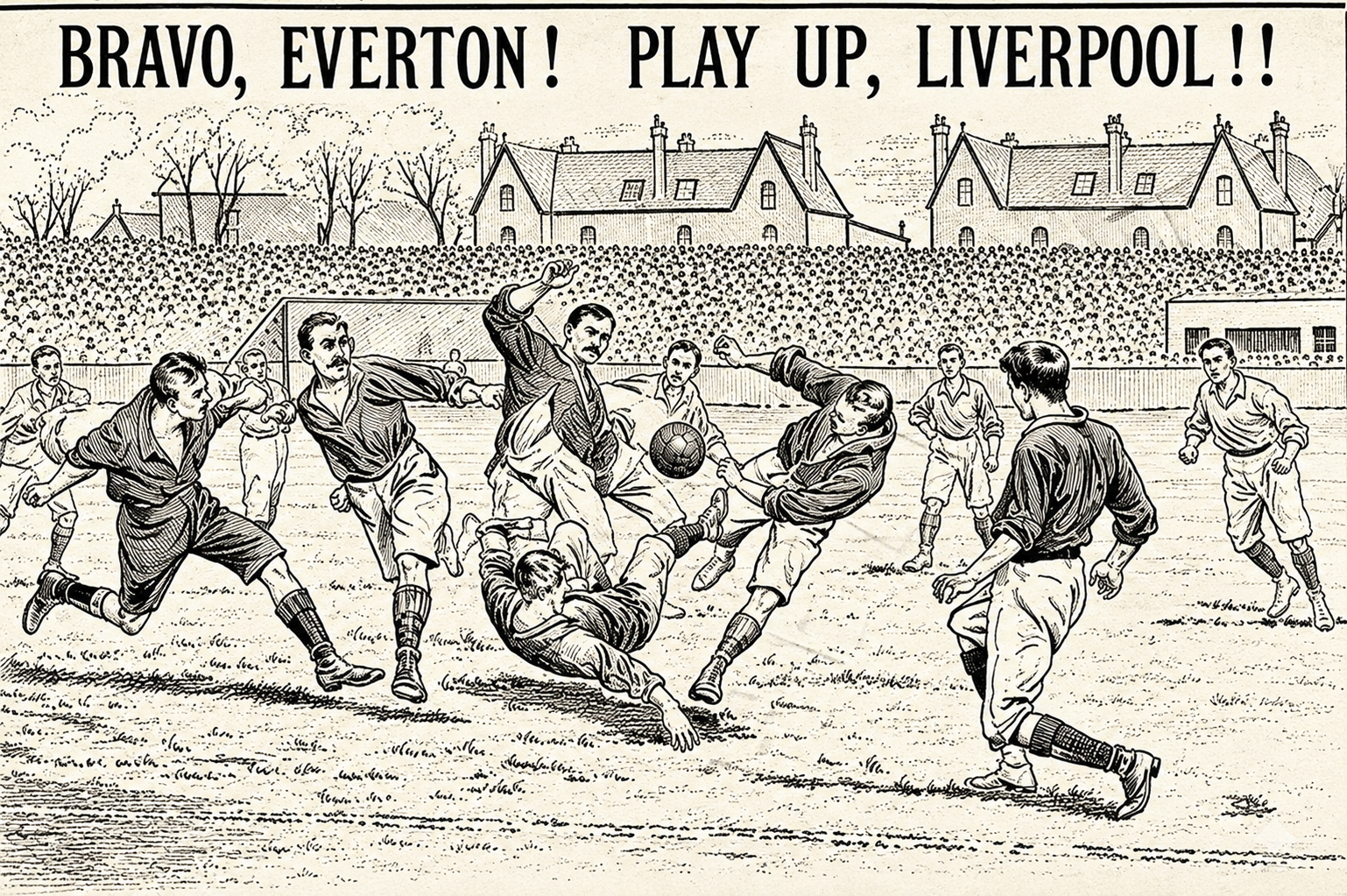
Goodison’s Greatest Games: The First Goodison Derby
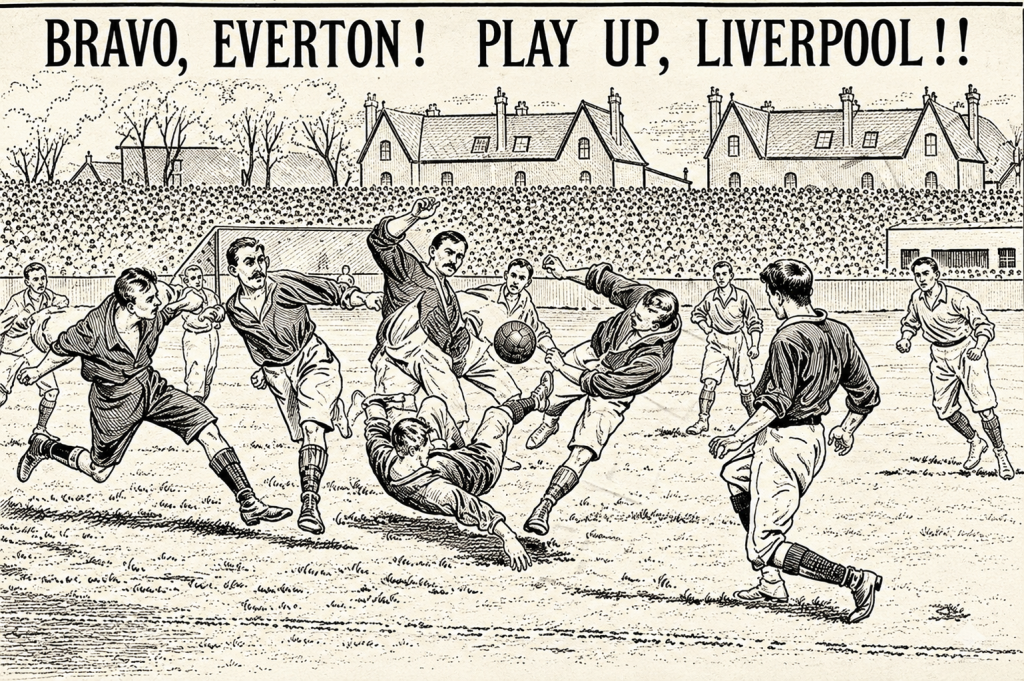
The date was 13 October 13 1894. The occasion, not just the first Derby at Goodison Park but also the first league meeting between the city’s footballing giants.
Although it was the first time these two had met in the league, it wasn’t their first head-to-head. The date for that was April 1893 and the occasion was the final of Liverpool Senior Cup. The encounter, between Liverpool and what was essentially Everton’s reserve team was settled by a single goal in Liverpool’s favour.
There had also been a Liverpool v Everton head-to-head back in 1885 but this was a charity match to raise funds for Stanley Hospital. And the Liverpool team involved was a collection of local footballers drawn from the ranks of Liverpool Ramblers, Bootle and Cambrian, not the red monstrosity that would go on to torment the Blue half of Merseyside in the distant future.
Although there might not have been much history between the two sides to fan the flames of rivalry as we understand it today, prior to that first league encounter there was enough bad blood between the respective boardrooms to ensure that a degree of enmity was in the air.
The infamous ‘split’ in 1892, when elements of the Everton board had moved the club from Anfield to the newly built Goodison Park in response to a rent dispute with Anfield’s landlord (and Everton’s former president, John Houlding) had effectively given birth to our loathed neighbours. With an empty ground to fill, John Houlding had responded to Everton’s desertion by creating his own football club. In the spring of 1892, the Redshite were conjured into existence (possibly involving some kind of Faustian pact with the Devil)
Although recognised as a football club by the FA committee, Liverpool were initially refused participation into the Football League. But with their sophisticated stadium (by the standards of the time), Houlding’s finance and the organisational skills of John McKenna (the club’s first secretary), their case for inclusion could not be dismissed for long.
At the end of the 1892/3 season, Accrington resigned from the Football League and Bootle, who were unable to adapt to the costs of professionalism, lost their place in the second tier. Liverpool applied for both positions and were given the one vacated by Bootle in Division Two.
The club grasped the opportunity provided and adapted well to life in league football. At the end of the 1893/94, season they finished top, gaining promotion to the top flight. It was a victory that set them on a path to an inevitable meeting against their city rivals.
Because of the novelty of this fixture, the nature of the split and the proximity of the two clubs there was widespread interest in the match within the city.
‘I never saw such a crowd. As early as one o’clock all streets, for miles around, leading to Goodison Park began to be thronged with men, women, and boys, all tramping to one place. As far away as the Pier Head every tramcar was loaded with excited intending spectators of the game, and these, together with a heterogeneous assemblage of omnibuses, wagonettes, drays, pony carts, hansom cabs, four-wheelers, and every imaginable description of wheeled vehicle, formed a huge possession stretching (to take one route alone) from the bottom of Scotland Road right up to the ground’ wrote John Humphreys in the North Wales Chronicle.
For those attending, it was expected that they would see an Everton victory. The hosts were overwhelming favourites to win the game. Since joining the inaugural Football League, Everton had done well, finishing runners up in 1890, league champions in 1891 and notching up a few top five finishes in other campaigns.
Importantly, they also entered the Derby in scintillating form, having won all seven fixtures played so far that season, scoring freely while remaining resolute at the back. They topped the table and were an early tip for the title.
Liverpool, by contrast, had found the transition to top-flight football a difficult one to adjust to. At that point in the season, they had failed to register a single win and sat fourth from bottom with a miserly four points. They might have beaten Everton in that Senior Cup fixture 18 months earlier but that counted for nothing in the harsher, cut-and-thrust world of league football.
Aside from home advantage and divergent form, there was also the issue of incentives to bear in mind. So important was victory to the Everton directors, and so palpable the desire to put the club’s upstart neighbour firmly in its place, the players were being rewarded with a brand new silk hat each in the event of an Everton win. As a visiting team, when you realise your opponents are playing not just for ‘bragging rights’ but also a fancy new piece of millinery, you know you’re in for a tough game.
Contrary to the blue and red colours that have long been synonymous with each side, visually the teams lined up that day in a way that would confuse modern onlookers. Everton wore red while Liverpool opted for pale blue and white halves, something more akin to a Blackburn Rovers strip that has been put through the wash too many times. Red would not become their adopted colour until 1896.
Despite their long-held claims to possess a grand legacy in ‘pass and move’ football, Liverpool’s approach back then could best be described as ‘Sunday league’. This was ‘kick and rush’ at its most elemental. And there was particular emphasis on the ‘kick’ as Liverpool’s confrontational style met Everton’s more ‘aristocratic’ approach with relentless force.
Initially it was an approach that worked. Tackle by tackle, foul by foul, long ball by long ball, Liverpool edged to dominance, as Everton floundered under their physical onslaught. The visitors had their chances and could easily have gone ahead. But as their league form had illustrated, being clinical in front of goal was not Liverpool’s strong point.
Despite the early dominance of the men in washed-out pale blue and white, it would be Everton who took the lead, when McInnes rose with perfection to head the hosts into a one goal lead after ten minutes.
For the remainder of the half, Liverpool searched for an equaliser, carving out a number of further chances through their tenacious approach. But it was to no avail. Although at times dominant, they went in at half-time one down.
As the second half commenced, Everton’s technical superiority began to make itself felt. Chances for the home side became more regular as Liverpool’s momentum visibly ebbed. On 60 minutes, Latta made it 2-0. It was a goal that appeared to put the match beyond the visitors. From that point on, Liverpool no longer seemed able to trouble the hosts.
As Everton played with ease, a third goal for the home side seemed inevitable. It arrived late on, as a north west sky unleashed a torrent of rain upon proceedings. Bell, the final member of a Scottish triumvirate that had seized the day for Everton, popped up in the box to make 3-0.
Not long after, the final whistle blew. The Reds had won, to the delight of the directors and fans alike. The local upstart had been firmly put in its place. Silk hats all round!
Despite the comprehensive scoreline, John Humphreys believed that ‘taking the play all through I must express … it was not Everton’s defence that saved them from a defeat but the miraculously bad shooting of the Liverpool forwards. This was no doubt due to the tremendous excitement they were labouring under, and no doubt the excitement had a lot of effect on the Everton men. Had Liverpool scored once, their chances of winning the match … would have been five to one.’
But although he believed that Liverpool had been unfortunate not to have come away with a victory, when pondering the assertion made by Liverpool’s Jimmy Ross that the Anfield fixture would go their way, Humphreys strongly disagreed:
‘Everton, despite what I have just written, is a better team than Liverpool, and I can hardly believe that at any following match the Anfielders will or can ever again develop such a tremendous amount of steam as they did last Saturday, and unless they do, they stand no chance against their mighty rivals.’
Everton would go on to finish that season as runners-up behind Sunderland. By contrast, Liverpool’s poor form would continue and they ended the campaign bottom of the league (going on to be relegated after a play-off defeat). Although the men from Anfield won promotion straight away the next season, it would be a further three years before they finally beat Everton, a 3-1 win in 1897 at Anfield.