Dave Hickson - The Cannonball Kid
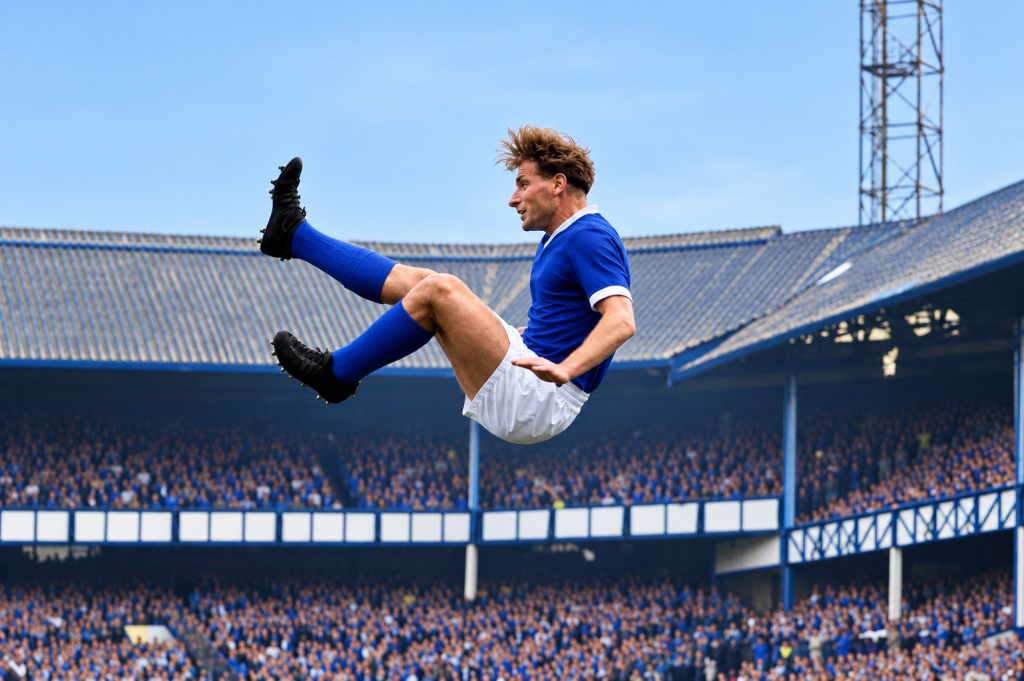
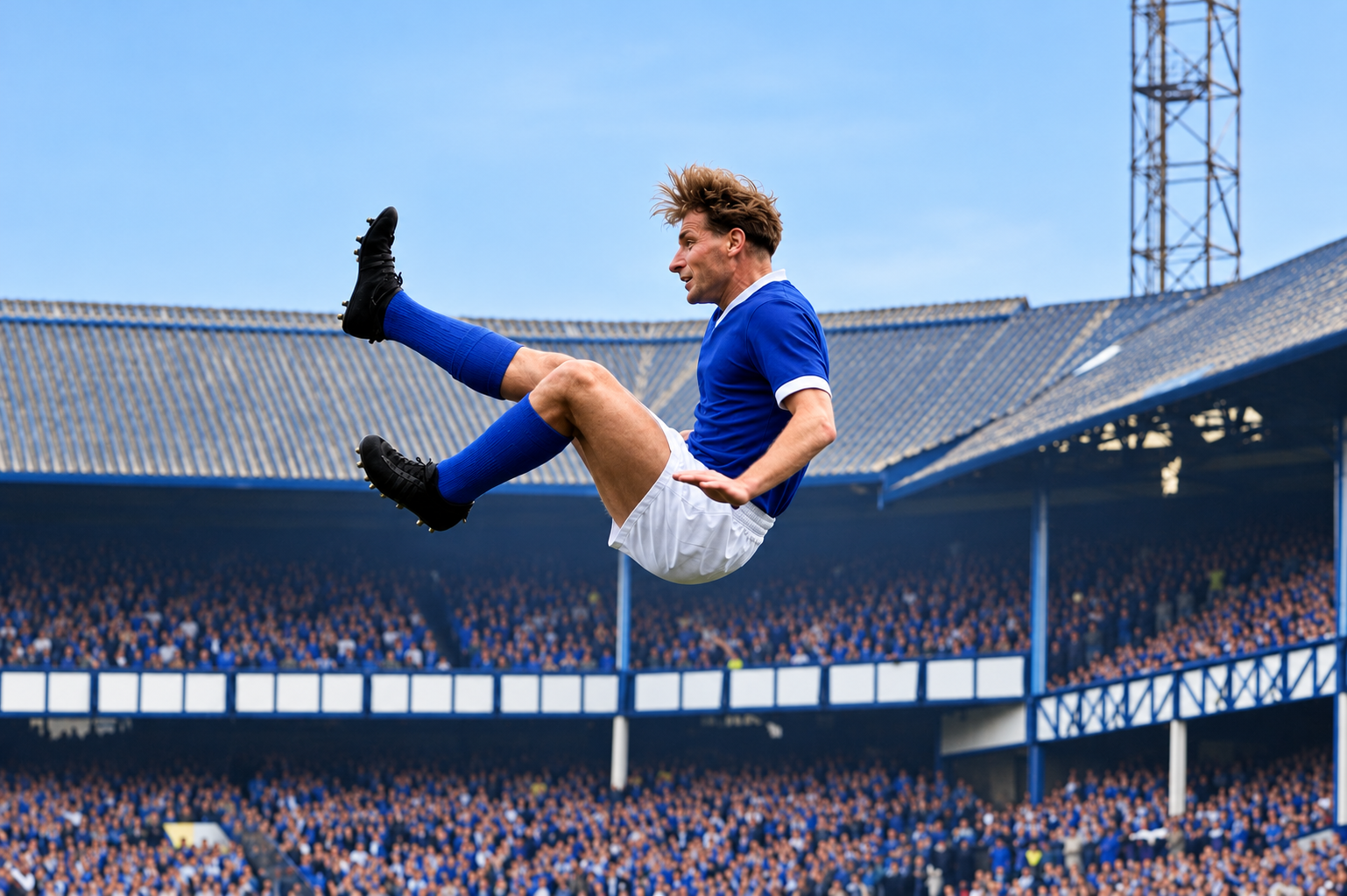
He was the player who would’ve died for the club; the uncompromising, old-fashioned centre forward who helped drag Everton out of its Second Division doldrums. He was Dave Hickson, the ‘Cannonball Kid’.
Hickson, was born in Salford in 1929 but raised in Ellesmere Port. Like most young boys, he fell in love with football, playing games ‘behind the wood’, alongside the cemetery on Rossmore Road East. It was where the boys playing would harbour ambitions of joining the list of greats to come from the town, players like Joe Mercer and Stan Cullis (Wolverhampton Wanderers), two Ellesmere Port lads who had gone to captain the national side.
Hickson, a talented player throughout his youth, was brought to Goodison from non-League Ellesmere Port in May 1948, aged 18. The rookie’s potential was clear, but his momentum was halted temporarily by two years of national service. For some, this might have been a set-back, years of vital football development lost. But Hickson was fortunate. While stationed nearby, he began playing for the Cheshire Army Cadets, a side who were coached by none other than Bill “Dixie” Dean. Like Lawton before him, Hickson ended up learning from the best during his later teenage years.
According to Hickson, it was thanks to Dean that he honed his famous heading ability. Although not even Dean could say he shared the same tenacity as his young student. Hickson became defined as a player with an almost reckless sense of courage, often putting his head into places where most would be wary of putting their feet.
Once back at Goodison, with national service completed, the side that Hickson began to slowly break into during the early 1950s was not one of Everton’s finest. Back then, the club was ruled by a board which seemed determined to hold on to the austerity aesthetic that had so characterised Britain in the late 1940s: the culture of ‘running a tight ship’, of ‘every penny counts’, of ‘make do and mend’. In short, they were tight arses.
As such, the club’s prevailing ethos was to put faith in youth (augmented by cheap acquisitions from the lower leagues and Ireland).
It was this approach that led eventually to relegation in 1951. But the misery didn’t initially end there. Life in the second tier proved tougher than expected, and, for a time, Everton laboured. At one point, early in the club’s second campaign, the Blues were bottom of the league – thoughts of an unprecedented drop to the Third Division North haunting those who followed the club.
‘It was bleak at times back then’ says John Bohanna, who first began watching the club in the late-1940s. ‘When we first went down hope was thin on the ground. That’s part of the reason why a player like Hickson developed such a connection with the fans. He was a ray of light after so much gloom. He gave that sense of hope that had been so sorely absent.’
As that second campaign had progressed, optimism had grown incrementally. The approach of the board might have been largely disastrous, but that isn’t to say that the faith in youth didn’t sometimes bear fruit. Young players such as T. E. Jones, John Willie Parker and Dave Hickson started to make their mark on the first team.
Of these, Hickson was unquestionably the highlight for the fans. Ask any Evertonian who followed the club in the 1950s to name their idol and they will invariably point to the ‘Cannonball Kid’.
‘He was an old-fashioned centre-forward. With his towering blonde quiff, his physical style and a decent eye for goal, Hickson gave us Blues something to get excited about,’ remembers lifelong Evertonian, John Flaherty.
Hickson was tenacious to the point of self-harm. It was a level of commitment appreciated by the Goodison faithful, who responded to a player who appeared to give his heart and soul for the club every Saturday afternoon.
‘I think Evertonians, as much as they appreciate skill, have always taken to their hearts players that give their all for the club. And Hickson was the embodiment of that sort of player. That was part of the reason behind the nickname, the ‘Cannonball Kid’. Along with the ferocity of his shot, he was a handful on the pitch, for everyone, including the officials. He put himself about, he argued, he never gave up on anything. Hickson had a strong desire to win the game, and that came out in his personality when he played’ Flaherty continues.
If you had to choose one game to illustrate the combative approach of Hickson, to reveal just why Evertonians loved this player so much, it would be the fifth round FA Cup tie that took place against Manchester United on Valentine’s Day, 1953.
Everton welcomed the champions to Goodison on the back of an improved spell on the pitch. As ‘Stork’ reported in the Liverpool Echo, a resurgent Everton were not to be underestimated in the cup tie.
‘Manchester United will have to sit up and take notice of this Everton team which has not lost a game since January 3. For it has become a competent footballing side with a high degree of confidence in itself.’
Although United went ahead early on, Everton remained in the game and just past the half-hour mark, were rewarded for their efforts when Tommy Eglington equalised, benefitting from wonderful build-up play from Hickson.
The ‘Cannonball Kid’ had been on great form all afternoon, linking up with Parker and Eglington, winning everything in the air, remaining a constant nuisance to the United defenders. But, five minutes from the break, with the game hammering back and forth, Everton appeared to have been dealt a devastating blow when Hickson dived to connect with a cross, another example of his fearless commitment to the Blue cause. For his efforts, he received a boot to the head. With blood streaming from a cut above his left eye, he was ordered off the field.
‘It was typical of Hickson to do something like that’ remembers John Flaherty. ‘He was a blood and thunder kind of player. A gladiatorial player. You’d lose count of the number of times he did something reckless, going for balls that nobody else would think of going for. He just had that mentality, a desire to win to the point of self-harm.’
Half-time came and went, but without Hickson initially remerging. Unbeknownst to the crowd, he was being patched up by Harry Cooke, the Everton physio. To the relief of those crammed into Goodison, a few seconds after the Everton side had run out onto the field, that recognisable blonde quiff emerged from the tunnel, replete with a hastily stitched-up wound above his right eye.
Shortly after he returned, as Hickson described in his autobiography, The Cannonball Kid, a second collision, this time with the post, almost spelled the end of his game that day:
‘There was blood and all that everywhere. At this point, the referee, Mr Beacock of Scunthorpe, suggested to Peter Farrell [the Everton captain] that I should leave the field.
“He’ll have to go off,” said the referee. “He can’t go on with an eye like that. He’s not normal.”
There was no way I was going off the pitch, no way at all. “I am normal,” I told him. “Tell him I’m normal, Peter, tell him!” “Of course, you are Dave,” said Peter.
“There you are, Ref,’ I said. ‘I’m staying!”
Blood oozing from his wound, Hickson continued, a decision that paid off not long after, as the man himself later described:
‘On 63 minutes came the game’s decisive moment. I took Tommy Eglington’s pass on my chest, beat one man, sidestepped another and hammered a right-footed shot beyond the reach of Ray Wood and into the net. Goodison erupted in celebration. It was a wonderful moment.’
The goal was enough to secure the win, giving Evertonians the kind of big Saturday afternoon scalp that had been sorely lacking at Goodison for some time. Although the Blues would get no further than the semi-final, eventually being knocked out by Bolton Wanderers, United’s defeat seemed like confirmation that the recent up-turn in form was based on sound foundations, that better things were to come. And in the season that followed, that proved to exactly be the case.
‘With Hickson leading the line, and some of the other younger players really finding their feet, the side looked better from the beginning. All season we were in the hunt for promotion’ says John Bohanna.
And, according to Bohanna, in contrast to the dirge that had characterised recent campaigns, Everton were also playing attractive, swashbuckling football.
‘Along the way, teams were often dispatched by big score-lines. Derby County 6-2, Brentford 6-1, Plymouth 8-4! These were scorelines more in keeping with the Dixie Dean era.’
A key element in this was the partnership that developed between Hickson and Parker. ‘He was an excellent inside-forward,’ Hickson later wrote of Parker. ‘We had a good working relationship and with that, you always know what the other fellow is doing … John Willie was really my partner in crime. We each knew what we were going to do.’
There was also, as Hickson explained in The Cannonball Kid, an emergent sense of team camaraderie, underlined by a grim determination to reverse the club’s fortunes.
‘There was a real resolve among us to get Everton back where they belonged in the top flight. We sat down at the start of the 1953/54 season and resolved to do it. I think the spirit was all over the club.’
As the final game approached, Everton sat outside the promotion positions. Above them were Leicester City (56 points) and Blackburn Rovers (55). Importantly, both had played their final games, giving Everton (who had 54 points) the opportunity to leapfrog Blackburn and in the process get back into the First Division. If the Blues managed the improbable feat of beating upcoming opponents Oldham 6–0, that would also be enough to see them crowned champions.
‘There aren’t a lot of Blues left who can remember what it was like to be in the Second Division,’ says John Bohanna. ‘It was tough. Ever since, whenever we have been down near the bottom of the top flight, I’ve had cold sweats and sleepless nights because I know what the reality of relegation is like. We had to get out of that league. It was as simple as that. The last game of the season was as important as any that has taken place in Everton’s long history.’
That the club was in any position at all to countenance the idea of promotion was thanks to Hickson’s contribution in the season’s penultimate game, as the Liverpool Echo reported:
‘Hickson has scored many extremely valuable goals for Everton but none of greater significance than his splendid header at the 38th minute against Birmingham. Had it not been for that goal, we should not now be caring two straws about the game at Oldham, as Everton’s promotion chances would have been extinguished.’
Should Everton achieve promotion at Boundary Park, it would restore the club as the kings of the city once more. Although this was still the age of ‘friendly rivalry’, when Blues and Reds would regularly go to each other’s games, there was just enough competitive spirit between the two clubs for Evertonians to take satisfaction from the fact that Liverpool would be heading down just as Everton returned to the top.
The game was a late kick-off, so the exodus from Liverpool began early. People took the afternoon off, and by early evening Oldham town centre was awash with Evertonians.
‘Oldham had never seen anything like it,’ remembers Tony Onslow of the Everton Heritage Society. ‘We were there mob-handed. They tried to stop people bunking into the ground by putting tar on the walls. But it made no difference. The young kids just put newspaper over it and climbed over. The tar still got all over them, though. There was a report in the local paper that referred to the Blues as the “tar babies” of Everton.’
Everton were rampant that day, blowing Oldham off the park. With just 35 minutes gone, they had raced into an unassailable 4-0 lead. Hickson had bagged the fourth goal, a glorious solo effort that had seen him run half the length of the field, beat three men and drive the ball beyond the keeper’s reach.
‘It was a goal that sealed promotion in the minds of anyone watching. Everton had been breath-taking and Oldham non-existent. We knew that if we got two more and kept a clean sheet, the title would be ours too. I think at that point most Blues in the ground thought that’s exactly what would happen,’ says Onslow.
But the title wasn’t to be. For all Everton’s endeavours, the remaining two goals would not come. Not that it mattered to the Blues who had made the journey. ‘Thousands of them swarmed on to the pitch and hoisted Farrell the Everton captain shoulder-high carrying him in triumph to the entrance to the dressing room,’ reported Ranger in the Liverpool Daily Post.
For Dave Hickson, whose goals and work ethic had done so much to get Everton back into the top flight, that moment is one that remained with him for his whole life, as he later recalled in The Cannonball Kid:
‘It was the highlight of my career,’ he wrote. ‘Even now when people stop me and say, “Hi, Davey”, I think it’s because they look back at the time when we got them back up to where they are now. I think people remember that time, even if they weren’t around to see or experience it. Evertonians are very good with their history and there’s a sense of recognition that I was part of a side that got them back to where they belong.’
Once back into the top flight, although Everton shone in periods and Parker and Hickson continued to score, under-investment and a lack of quality held the team back. As too did some of the managerial decisions taken by Cliff Britton.
Two games into the 1955/56 season, one such decision had a dramatic impact on the club’s relationship with its star forward. Britton dropped Parker and Hickson, and in response, the ‘Cannonball Kid’, asked for a transfer. It was the tipping point for Hickson, the last straw. He was frustrated by a board and a manager who he felt were stopping the club from reaching its potential. Within a fortnight he was at Aston Villa, sold for £19,500.
It turned out to not be a happy move. Hickson failed to settle in the Midlands and so found himself on the road again after just two months, ending up at Huddersfield Town – this time for a fee of £16,000. Although he performed well at Leeds Road, he’d joined a side in decline and could only watch on as the Yorkshiremen slipped into the Second Division at the season’s end.
But to the delight of Evertonians, the Dave Hickson story at the club wasn’t over yet. After averaging better than a goal every two games for Huddersfield, Hickson delighted Blues by returning to Goodison for £7,500 in August 1957.
‘It was great to have him back’ says John Flaherty. ‘Hickson was always a crowd favourite and he’d been missed by the fans. To see him coming out and playing for us again, was just what we wanted.’
Though Everton languished in the wrong half of the table, Hickson continued to hit the target regularly, remaining great value for the modest outlay. But when a new manager arrived at Goodison, Johnny Carey replacing the outgoing Ian Buchan in 1958, a change was in the air. Carey was in the mood for rejigging the struggling squad and as part of that signed off on a controversial move, selling the 30-year-old Hickson to Liverpool for £10,500.
The shock move created outrage at the time. So incensed were some Evertonians, and so committed to their idol, that they claimed they were willing to defect to Anfield. While there were those amongst the red half of the city, who vowed that they would give up supporting their beloved club in protest, furious at the arrival of a player who was so indelibly connected to Goodison.
In the event, Hickson proved to be a hit, silencing the naysayers with his committed performances. His cause was inevitably helped by the fact that on his Liverpool debut, at home to Aston Villa, Hickson scored both goals in a 2-1 victory – one of them a trademark diving header.
Despite thriving across the Park, the arrival of Ian St John in May 1961 would ultimately spell the end for Hickson’s Anfield dalliance, and in the summer of that same year, he was released to join non-league Cambridge City.
But he was not finished with the Football League just yet. After a very brief sojourn at Cambridge, he bounced back briefly with Second Division Bury early in 1962. From there, he then completed his hat-trick of Merseyside employers by spending two seasons with Tranmere Rovers in the Fourth Division.
The move to Prenton Park gave him the rare honour of being one of only a handful of players to have turned out for three Merseyside clubs, joining John Heydon and Frank Mitchell, who also played for Everton, Liverpool and Tranmere Rovers and Bill Lacey and Neil McBain, who played for Everton, Liverpool and New Brighton.
Hickson scored regularly at Tranmere, before finishing off his career by taking a number of player-manager positions at clubs including Ballymena United, Bangor and Elsmere Port.
But despite his many moves, his heart always belonged to Everton. ‘I’ve been to a few clubs, great clubs’ he once said, ‘Aston Villa, Huddersfield, Liverpool. But Everton… there’s something magic about it. I’m just an Evertonian that’s all.’
It was a love that was repaid by Bill Kenwright when he asked Hickson if he wanted to ‘come back home’ to Goodison after he retired, working there as a match-day host and stadium tour guide, giving generations of Evertonians the chance to spend time with the great man.
He passed away in July 2013, aged 83, after giving decades of service to the Blues. Along with the goals he scored, Hickson left behind a footballing legacy to be proud of and also possibly one of the greatest ever quotes to encapsulate a player’s love for their club.
‘I would have died for Everton', he said. ‘I would have broken every other bone in my body for any other club I played for but I would have died for this club.’