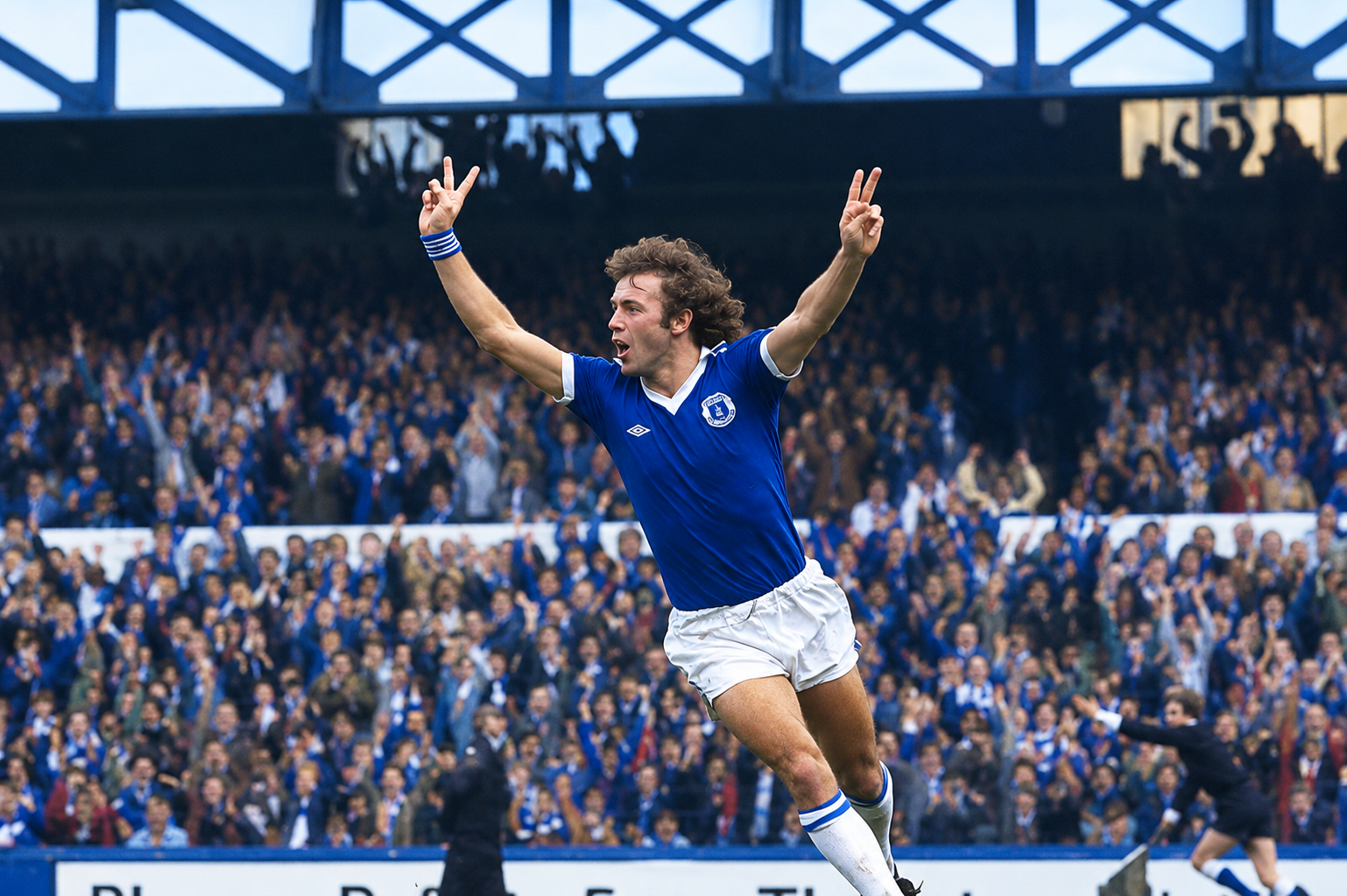
Andy Is Our King
When Liverpool visited Goodison in the autumn of 1978, it had been 362 weeks since Everton had bested them in a head-to-head. Over the past fifteen derbies, Liverpool had won eight and drawn seven. Failure to beat them on that day would make it seven years without a victory.
‘People moan, justifiably, about us rarely beating Liverpool nowadays but back then you also have to take into account that not only could we not defeat them, we also had to watch as they won everything. So, you have to put the lack of Derby victories in that context too. When it came to Liverpool, the 1970s were a very dark time for Evertonians, probably the worst ever endured’ says Dave Kelly of the Blue Union.
Despite Everton’s often erratic form during the 1970s, prior to that Derby, matters on the pitch had been looking up. Since Gordon Lee had arrived, Everton’s outlook had improved markedly. Although in its relative infancy, the 1978/79 season was looking good for the Blues.
‘We were doing well early on. Both us and them had set the pace and that game pitted first (Liverpool) against second (Everton). It had been a long time since we were that close’, Kelly continues.
Despite the Blues improved form, for those heading to Goodison, there was a sense of unease that would be familiar to those who follow the club today
‘Liverpool were so good back then and their record in Derbies so impressive that you went to those games fearing that we could get turned over. Even if our form was good. It was a bit like it is nowadays. They had a psychological hold over us’, recalls Phil Redmond, formerly of WSAG.
On an unseasonably hot October afternoon, 53,000 crammed into Goodison to watch what Match of the Day, in a rare example of pre-Sky hyperbole billed ‘THE MATCH OF THE SEASON!’.
‘I remember there being a huge build up to that game. It felt like a cup match. I was sitting in the top balcony, down by the Park End. After playing footy in the morning, I got down there early enough to see all kinds of “entertainment” on the pitch, the weirdest of which was the police dog displays. The club was really making the effort beforehand for some reason’, Redmond continues.
Liverpool were unchanged from their previous game, boasting the side that had taken the league by its throat. Everton, by contrast, had one key absence, with Mick Lyons out injured, Roger Kenyon was deputising for him at centre half.
‘You look at those two sides and in one, Liverpool’s, there are no weak links. In Everton’s, the likes of Mickey Walsh and Geoff Nulty suggested a side that couldn’t match Liverpool player-for-player, so would have to work a lot harder for any chance of a win’ remembers Brian Viner, author of Looking for the Toffees: In Search of the Heroes of Everton.
A raw and raucous atmosphere in Goodison seemed, as it often does on Derby day, to be reflected in what unfolded on the pitch. From kick-off, the play was frenetic; tackles flew in, movement a blur, the rhythm of the game played at the highest of tempos.
Watching those two sides, you would never think that Liverpool were the kings of Europe and Everton their overshadowed neighbours. Recent history seemed to mean nothing at all as the Blues took the game to Liverpool with an attacking display that would shame some recent Everton sides. In a first half that rang with blood and thunder, it was the home side who always seemed to carry the greater threat.
Aside from Souness’ speculative effort at the Everton goal, Liverpool offered very little in the first half. The chances, when they arrived fell to instead the Blues. Latchford came close early on, putting a header wide and later forcing a smart save from Clemance. He then had the best chance of the game when a mix up between Clemance and the Liverpool centre-halves presented him with a tricky header into an open goal. Agonisingly for those watching behind in the Gwladys, the ball trickled inches wide.
‘Even though this was Liverpool, the kind of side you could imagine getting out played and still nicking a jammy win, at half-time it felt good that we had been so much better than them. Despite yourself, you felt like this could be our day. When it came to Derbies it was rae to feel like that’, recalls Phil Redmond.
Under a floodlit pitch, this time switched on to compete with the sunlight, Everton (attacking the Park End) started the second half on the front foot almost immediately. A sublime cross by Thomas nearly put Nulty in. But although he flung himself at the ball, the Everton midfielder couldn’t quite get his head to the cross.
It felt like the game’s momentum was with Everton and that a goal was on its way. But it would take a moment of magic for one to be conjured up. And on this occasion, the magician in question was Andy King.
King was just 19 when he moved to Goodison from Luton Town in April 1976 for £35,000. Almost on arrival he was taken to the hearts of Evertonians.
‘There was just something about him that we loved, remembers Dave Prentice, formerly of the Echo. ‘Maybe it was his chirpy, effervescent personality or maybe it was because he ‘bought’ into Everton. It was clear very quickly (and later confirmed by the many kind things he’s said about the club) that he became an Evertonian once he had arrived. I think the fans always have a soft spot for those who choose to become a Blue. And that was King.’
Always capable of a moment of magic, this busy midfielder was about to score his most important goal for the club.
‘I remember Mike Pejic looping a ball into the box which was headed down. I could just about make this out through the glaring sun’, says Brian Viner.
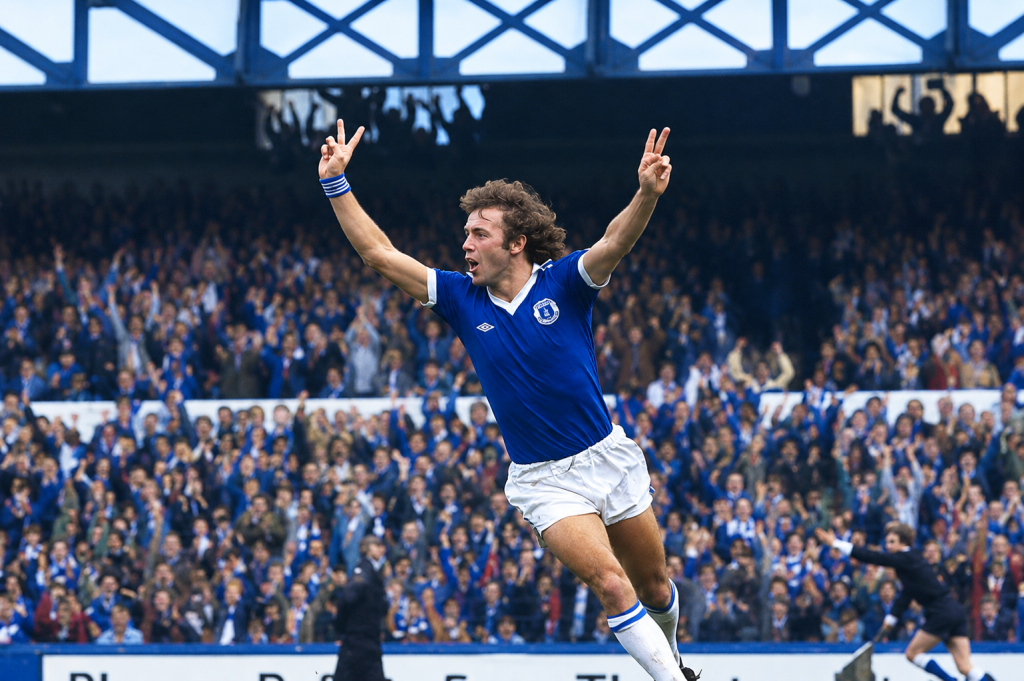
The ball bounced right outside the box where it was met by the onrushing King. The midfielder adjusted his body to account for an awkward bounce and then let fly. To the delight of every Blue inside the ground, he caught it sweetly. The ball flew over the fingertips of a beaten Clemance and exploded into the top corner.
‘To this day I can see the ball curling away from Ray Clemence and as soon as it was hit… you just knew. Cue complete euphoria and insanity. The Old Lady was at her best and was shaking, we were all just being carried around in waves of people, arms around each other, fists clenched, holding and shaking each other. It was complete bedlam’, remembers Mike Constantinou, who was stood in the lower Street End.
A tale later told by King to talkSport, possibly apocryphal, possibly not, gives a beautiful illustration of the enduring difference between the two clubs, one that was as relevant back then as it is today.
‘The story goes, and it’s true’, he recounted to Richard Keys ‘that Souness, as I’d hit it said ‘you’ve missed’. I turned to him as it went into the top corner and said, ‘I did. I was aiming two inches to the left.’
Whether true or not, the story has a nice ring to it, contrasting the effervescent glee of the underdog with that of the dour, unsporting sourness displayed by the perennial winner.
In response to being one down, Liverpool (inevitably) upped-their game and not long after nearly silenced Goodison when David Johnson put the ball in the back of the net. Most Evertonians probably think otherwise but sometimes the officials can come to our rescue in Derbies. The flag went up before Johnson had struck and the goal was ruled offside. With that, Liverpool’s brief resurgence started to run out of steam.
As the game edged towards conclusion it was Everton who would come closest to scoring, when Dave Thomas had his goalbound shot cleared off the line by Alan Hansen (who opted on this occasion to use his foot rather than his hand).
‘When the final whistle went, Goodison went mad’, remembers Brian Viner. ‘I think that we gave more voice that day than we had six months earlier when Latchford scored his 30th. Goodson was hysterical. We’d actually been signing ‘Bobby Latchford walks on water’ during the game. But for the remaining half-hour or so, the ground shook to a chorus of “Andy is our King, oh Andy is our king, oh Aaaandy is our King!”.’
After the game, as jubilant Blues danced around their hero, BBC North West Tonight’s Richard Duckenfield stuck a microphone under the nose of King. “Andy King …” a local bizzie hovered into view and started to barge the pair down the nearby player’s tunnel. “Can you get off the pitch!” he barked, marking his allegiances for all to see.
We never got to hear Andy King’s thoughts. But that might be just as well as his goal probably said more than any words could.
‘In a time when Evertonians had so little to cheer, that was a unquestioned highlight’, argues Dave Prentice. ‘The 1970s, specifically when it came to Liverpool, had been really hard for us. It’s probably difficult to explain to modern fans what it felt like to live so comprehensively under their shadow. So, to beat them, finally, was wonderful. So magical in fact, that it stands out as one of my greatest moments as a Blue.’
Blues of all ages got to experience something after that game that had been denied them for so long; a proper post-match gloat.
‘After so many Monday mornings going into school and having to put up with their smug faces, it was great to go in and give the Reds in my class loads. The novelty of the experience was made all the sweeter when you saw just how pissed off they were’, remembers Phil Redmond.
Although, according to Redmond, the reaction of some was a bit of an eye-opener for one as young as him:
‘I think that was the first time I realised what a bunch of shitehawks they really are. I had a go at one mate and he shot back sourly, ‘how many European cups have you won? Typical Redsh**e, can’t lose graciously even the once. Can’t even give us that’